PC₃ AMI & AMII Modules Outline
PC₃ Advance Modules I & II Syllabi
Department of Chemistry
COURSE CODE: COURSE NAME
Winter 202? (Jan - Apr 202?)
Instructors:
The local instructor at UNIVERSITY NAME is Dr. INSTRUCTOR NAME (EMAIL).
Content will be presented by several external instructors:
The AMI Module (DFT Methods, Solid-State Modelling, Relativistic Effects) will be presented by Dr. Erin Johnson from Dalhousie University (erin.johnson@dal.ca), Dr. Tom Woo from the University of Ottawa (twoo@uottawa.ca), and Dr. Georg Schreckenbach from the University of Manitoba (schrecke@cc.umanitoba.ca).
The AMII Module (Reaction Energies and Kinetics) will be delivered by Dr. Gino DiLabio from The University of British Columbia (Gino.DiLabio@ubc.ca) and Dr. Alberto Otero de la Roza from the University of Oviedo (oteroalberto@uniovi.es).
Lectures:
Synchronous lectures will be held on Days from start time to end time (Pacific Time) over Zoom. Advanced Module I will be offered from start date to end date. Advanced Module II will be offered from start date to end date. Links will be provided to the class by email. Students are expected to have a working microphone and webcam for discussion. Instructors may require that students keep their cameras on during lectures.
Module length:
AMI: First half of the semester
AMII: Second half of the semester
Prerequisite Knowledge:
A grade of C- or better in introductory courses in quantum chemistry or physics and/or computational chemistry. Completing the PC₃ Intro course is strongly recommended.
Course Description:
Advanced Module I will present the fundamental principles of density-functional theory (DFT) and its application to the practical modeling of molecular and solid-state systems, using periodic boundary conditions. Special attention is given to the treatment of relativistic effects for heavy elements.
Advanced Module II will present the practical aspects of the calculation of key properties relevant to thermochemistry and chemical kinetics. Students will work through the calculation of bond dissociation enthalpies, reaction energies and free energies, and reaction barrier heights.
Focus will be placed on organic reactions while the general principles and computational methods presented are applicable to all chemistry.
Course Objectives/Learning Outcomes:
Upon completion of Advanced Module I, students should be able to:
-
Explain key concepts in DFT
-
Perform derivations involving density functionals
-
Understand the basic principles of solid-state electronic structure
-
Carry out solid-state and surface calculations with DFT
-
Select an appropriate functional for a given problem
-
Qualitatively explain relativistic effects in chemistry
-
Demonstrate a working knowledge of different approximate relativistic methods.
Upon completion of Advanced Module II, students should be able to:
-
Perform quantum mechanical calculations to obtain chemical properties such as bond dissociation enthalpies, reaction energies, and barrier heights including consideration of:
-
Thermally accessible molecular conformations and Boltzmann distributions;
-
Effects of non-covalent interactions;
-
Effects of solvation, using implicit and explicit solvation models;
-
Effects of level of theory and basis set;
-
Use of thermal corrections derived from statistical mechanics;
-
-
Perform orbital analyses on molecular structures to understand substituent effects on properties.
-
Propose and/or validate reasonable reaction mechanisms on the basis of experimental observations and computational findings using:
-
Transition state theory;
-
Barrier heights obtained by locating reaction transition states;
-
Orbital analyses.
-
-
Select appropriate quantum mechanical methods for a given problem and understand the shortcomings of methods in their ability to predict accurate bond dissociation enthalpies, reaction energies, and barrier heights.
-
Find and provide reference data from literature sources and understand some of their limitations.
Course Material:
There is no required textbook for this course. PDF copies of course notes, slides, and relevant scientific publications will be provided to students.
Course Assessment:
The grade for Advanced Module I will be determined from an equal weighting of three assignments, which will be given biweekly.
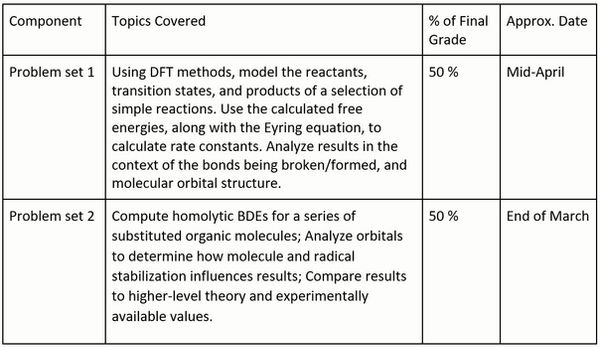
The grade for Advanced Module II will be determined from an equal weighting of 2 assignments:
At universities that have semestered courses, the Advanced Modules I and II will be a single course. The final course grade at these institutions will be the average grade for Advanced Modules I and II.
Completed assignments should be submitted to the instructor by email in advance of the specified date and time they are due. Late submission of the assignments will result in a mark of zero, unless the student has a legitimate excuse, such as illness. In this case, they must contact the instructor in advance of the deadline and will be granted an extension of a suitable length, to be agreed upon by the student and instructor.
Advanced Module I assignments will make use of electronic structure programs, such as Quantum ESPRESSO. Students should use their Digital Research Alliance of Canada (DRAC) accounts to make use of this software.
Advanced Module II assignments will make use of electronic structure programs, such as Gaussian 16 and Orca, and graphical user interfaces such as ChemCraft and Avogadro.
If a student does not have a DRAC account, they should contact the instructor-on-record for instructions on how to gain access. Students will be expected to be able to connect to DRAC resources remotely from their home computer via ssh, have facility with a Linux/UNIX environment (e.g. editing, saving, and manipulating files), and using the SLURM job scheduler, prior to beginning the course.
Students are expected to perform all electronic structure calculations independently and should save their input and output files. Students must have unique input and output files that they can produce upon request. Copying files from another student will result in a mark of zero on the related assignment.
Conversion of numerical grades to Final Letter Grades follows the UNIVERSITY NAME Common Grade Scale:
A+ (90-100%) B+ (77-79%) C+ (65-69%) D (50-54%)
A (85-89%) B (73-76%) C (60-64%) F (<50%)
A- (80-84%) B- (70-72%) C- (55-59%)
As this is a graduate module, a grade of B- or above is required to pass the course.
Course Content:
Advanced Module I will be divided into three equal parts, each of two weeks in duration: 1- DFT Methods, 2- Solid-State Modelling, 3- Relativistic Effects in Molecules and Solids. A list of topics to be covered in each part include:
Part I: DFT Methods
-
Kohn-Sham theory, the adiabatic connection, and exchange-correlation holes
-
The local (spin) density approximation
-
Generalized gradient approximations and enhancement factors
-
Hybrid functionals
-
Delocalization error
Part II: Relativistic Effects in Molecules and Solids
-
Relativistic effects in chemistry
-
Special relativity and the Lorentz transformation
-
Dirac Hamiltonian and the Breit correction
-
Approximate relativistic Hamiltonians and kinetic balance
-
Effective core potentials (pseudopotentials) as a relativistic method
Part III: Solid-State Modeling
1. Modeling surfaces and solids
-
Cluster models versus periodic models
-
Periodic boundary conditions
2. Introduction to the math of periodic systems
-
Plane waves
-
Direct Lattice
-
Wigner-Seitz cell
-
Reciprocal lattice
3. Plane waves as basis sets
-
representing a wave function with plane waves
-
cut-offs
-
Advantage and disadvantage of plane waves as basis functions
4. K-point sampling
-
Bloch’s theorem
-
Brillouin zone
-
Monkhorst-Pack sampling scheme
5. Pseudo potentials
-
Norm-conserving
-
Ultrasoft
-
PAW method
6. Periodic DFT modeling codes and Introduction to Quantum Expresso
-
Listing of periodic quantum modeling codes and packages
-
Introduction to using Quantum Expresso
-
Solid-state calculations and DFT calculations
-
DFT functionals for solid state properties
-
DFT + U method
7. Analyzing periodic electronic structure
-
Band structure calculations
-
DOS and projected DOS
-
ELF
8. Case Studies: surface calculations
Advanced Module II is organized in six blocks, corresponding to a week each. In each block, there are theory and practice sessions. The contents are:
Week 1, theory. Fundamentals of reaction chemistry: kinetic and thermodynamic control. Reaction rates and equilibrium constants and their relationship with the Gibbs energy of the system. Calculation of standard thermodynamic properties of molecular systems. Overview of the different factors and effects to consider in a thermodynamic calculation: solvent effects, thermal contributions, conformational exploration, etc. Overview of the electronic structure methods used for the calculation of the electronic energy (DFT, wavefunction theory): their approximations, computational cost, and limitations. Shortcomings of DFT: static correlation and multireference systems, delocalization error, dispersion. Effect of basis-set superposition error (BSSE) on the calculation of thermochemical properties.
Week 1, practice/demo. Apply DFT and wavefunction theory methods to calculate the electronic contribution to the reaction energy of a simple chemical reaction. Explore the effects of BSSE, and level of theory on the calculated reaction energy.
Week 2, theory. Review of the thermal contributions to the reaction Gibbs from statistical thermodynamics. Limitations of the harmonic oscillator-rigid rotor model: improving the treatment of low-frequency modes. Conformational contributions to the free energy: methods for conformational exploration and Boltzmann averaging.
Week 2, practice/demo. Calculation of the reaction enthalpy and Gibbs energy in the gas phase of a reaction involving a floppy molecule, with conformer exploration and Boltzmann averaging.
Week 3, theory. Effect of solvation on reaction energies. Implicit and explicit solvation models: methodology and accuracy. Accuracy of the calculation of reaction energies in the gas-phase and in solution with DFT: atomization energies, bond dissociation energies, reaction energies for common organic reactions. Interpretation of conformer stability and reaction energies with orbital analysis (hyperconjugation, frontier orbital interaction, etc.). Sources of accurate computational and experimental data for reaction energies.
Week 3, practice/demo. Calculation of BDEs for a family of substituted molecules. Compare calculated reaction energies to experiment and to higher levels of theory and interpret the results in terms of the DFT orbitals. Compare to higher levels of theory. Explore the effect of solvation on the reaction energy.
Week 4, theory. Transition state theory (TST). The Eyring equation for reactions in the gas phase and in solution. Calculation of the Arrhenius parameters. Thermodynamic formulation of TST. Advantages and limitations of TST. Tunneling corrections. Standard and variational versions. Application of TST to unimolecular reactions, electron transfer reactions, and others.
Week 4, practice/demo. Find the transition state of an organic reaction and explore the different techniques used to facilitate the location of the transition state. Calculate the rate constant using TST and compare to experiment.
Week 5, theory/demo. Use of TST to study the feasibility of proposed reaction mechanisms, with examples from the literature. Sources of kinetic reaction rate data from the literature. Effects of level of theory, basis set, solvent, and non-covalent interactions from adjacent molecules on the rate constant. Pre-reaction and post-reaction complexes. Conformational searches at the transition state.
Week 5, practice/demo. Propose two alternative mechanisms for the same reaction and use TST to examine the feasibility of each, taking care of selecting a reasonable level of theory, solvent effects, and carrying out a conformational search where appropriate.
Week 6, theory. Atom-centered potentials and their use for thermochemical calculations.
Week 6, practice/demo. Examine the reaction energy and barrier heights for a more complicated reaction using ACPs.